01 / 37
AI-Native Agency

The 9 AI Employees Your Agency Needs to Scale

The ultimate outcome

Build an agency that creates wealth two ways

Outcome 01

Owner cash flow

Move margins toward software economics, so more of every dollar you bill becomes cash in your pocket instead of payroll.

$1M
ARR per employee
Software
Margin profile
or
Outcome 02

Enterprise value

Own the systems, playbooks, and data that stay with the business instead of walking out the door when a person does.

Sellable
Asset, not a job
Zero
Founder dependency
The Problem

Agencies have adopted 10% of what AI can do today

01
Client expectations

Clients want more, faster, for less

Expectations reset the moment your client opened ChatGPT. More output, quicker turnaround, better work, and results you can point to.

02
Business model

The economics never actually changed

Revenue still scales by hiring. Margins sit where they were three years ago. Nothing you own compounds.

03
The owner

You are still the bottleneck

Drowning in delivery and people management. The work still routes through you, and AI has not taken a single thing off your plate.

The Cause

AI requires a skillset your agency has never had to hire for

Finding the use cases that move a number, encoding your expertise so a model can apply it, and deploying agents that run unattended. None of that is prompting. So the work lands on people already at capacity, using tools that hand back a draft somebody still has to fix.

Write the first draft yourself
40 min
Edit what the AI produced
55 min

So you bought AI and got slower, and you are still in every approval, every escalation, every hire.

What You Have Tried

Every agency is using AI

ChatGPT Claude Claude Code Canva Profound

All genuinely good tools. None of them is your employee.

01
Playbooks

They cannot run your playbooks

A horizontal tool knows how the world works. It does not know how your agency wins a pitch, scopes a retainer, or ships a campaign.

02
Expertise

Your expertise is not in them

The judgment that makes your work worth paying for lives in your team's heads. Off the shelf, none of it reaches the model.

03
Ownership

They need a specialist to keep running

Somebody has to build it, wire it into your stack, and fix it when the model changes. Rent the tool and you never own the leverage.

Atherial
Mike Fishbein, founder of Atherial
Mike Fishbein // Founder
Why listen to me?

We have run 50+ AI strategy and engineering engagements

10+ of them with marketing agencies, plus marketing use cases inside other businesses

Experience
6 years working in AI
Operator
Former content agency owner
The firm
Atherial is an AI‑native agency
Cards on the table

Here is where this ends: a free AI strategy call

What this deck gives you

The method for finding, building, and deploying the AI employees that fit your agency. Use it yourself.

AI-Native Agencies combine the best parts of services and software

Sells People
Legacy Agency
  • Revenue and headcount move together, always.
  • Margins sit at 20–35% because payroll scales linearly with delivery.
  • Business value is dependent on people.
  • You struggle to hire and retain top talent.
  • Your core competency as a founder needs to be hiring and training.
Hard to scale. Low valuation multiple.
Sells tools
AI Application Company
  • High margin (in theory) and scalability.
  • Tech IP and terminal value create a high valuation multiple.
  • Pricing is lower than an AI-native agency.
  • Less flexible to each customer's needs.
  • Does not yet handle the full workflow from strategy to execution.
  • Customers still operate the tool or need FDEs to customize it.
Customers buy software. They still own the work.
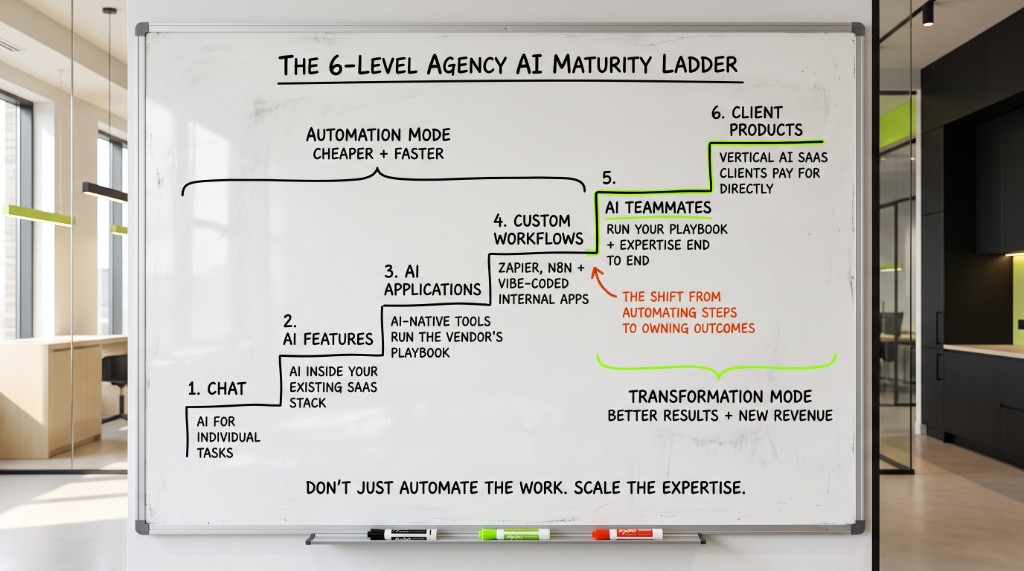
The 6-Level Agency AI Maturity Ladder whiteboard diagram
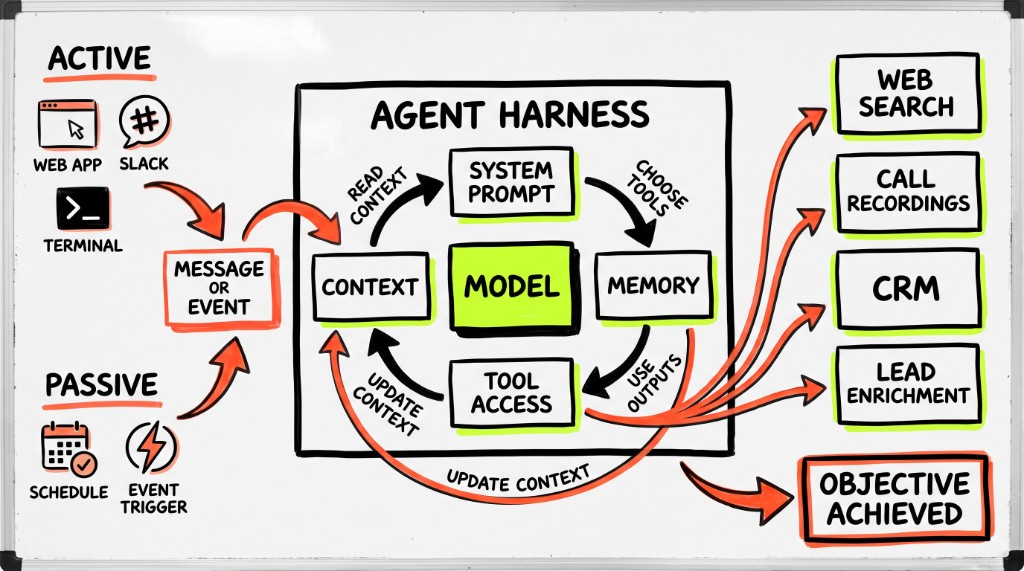
What is an agent?

An agent chooses actions and keeps working until it achieves an objective

Objective + context + tools + judgment + iteration

Agent harness showing active and passive triggers, context, model, memory, tools, and objective achieved
Start with the number

Start with a business goal, not an AI idea

Random Acts of AI
“What agent should we build?”

Interesting demos that often die on a shelf.

→
AI strategy
“What number must change?”

One measurable outcome connected to a deployed system.

The method fits on one slide

01Pick the numberStart with the revenue goal and the client mix that gets you there.
02Diagnose the constraintFigure out whether demand or supply is the thing actually holding growth back.
03Map the operating modelBreak the agency functions down into parts across Demand, Supply, and Back Office.
04Run SLEDScale what works, Launch something new, Enable what never made sense, Do recurring work.
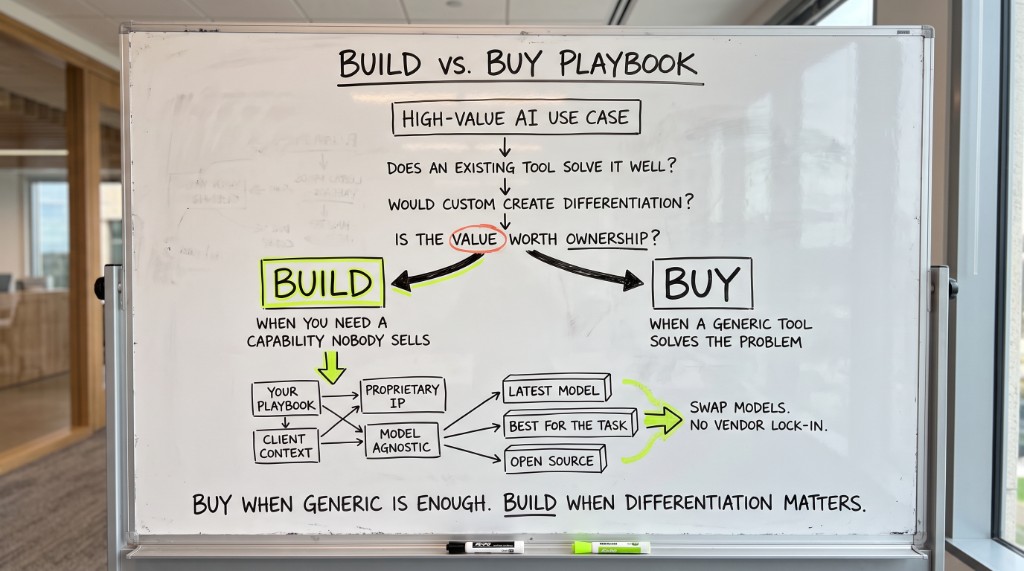
05Decide buy, configure, or buildBuy when generic is enough. Build when differentiation matters.
06Prioritize impact vs. effortShip high-impact, low-effort use cases first.
07Deploy, measure, and expandDocumentation, training, change management, measurement, maintenance.
Map the business

Every agency is three connected growth machines

01

Demand

Generate leads and close clients.

02

Supply

Deliver the work and manage accounts.

03

Back Office

Run finance, administration, and operations.

Great supply creates retention, referrals, and upsells, feeding demand again.
Demand machine

Demand is lead gen plus winning deals

Map the demand machine first. Every node is measurable, so every node is a constraint or a growth lever.

Graph 01

Lead Gen

Generate inbound and outbound leads from multiple channels.

Content Network Partnerships Ads Outbound
Gate

Qualify

Decide which leads deserve sales time.

ICP fit Budget / timing MEDDIC
Graph 02

Win Deals

Convert qualified leads through the sales motion.

Sales acumen Decks & proposals Lead follow-up Meeting prep
Close

Demo → SOW

Demo goes well. Send proposal or SOW.

Demo Proposal / SOW
The SLED Framework

SLED expands the AI opportunity beyond automation

S

Scale what already works

What is already working that you would do 10x more of if you had infinite headcount? ROI is proven because humans are already doing it manually.

Example: Repurposing your best content across every vertical and buyer profile you serve.
L

Launch something new

What channel, motion, or offer would unlock your next milestone if you could stand it up without hiring a team? Build it AI-native from day one.

Example: Standing up an AIEO (AI Engine Optimization) offer that is AI-native from day one.
E

Enable what was impossible

What would improve performance but you could never justify at human cost? Reviewing every sales call, researching every account, personalizing every update.

Example: Automated coaching delivered after every single sales call, not just the ones managers hear.
D

Do recurring manual work

What does your team do manually, every day? This is where most agencies fixate, but it rarely grows revenue. Do saves cost; Scale and Launch grow top line.

Example: Invoicing, status emails, and basic task automation. Useful, but not transformative.
Build vs. Buy

Coding agents wrecked the old build-vs-buy math

Jevons Paradox, applied to software

As the cost of building falls, demand for custom tools goes up

When technology makes a resource more efficient, consumption of that resource increases rather than decreases. Coding agents changed the cost of both building and maintenance.

1st
Internal Tool Build

Building internal tools used to be a microscopically small market. Now, most of our client builds are for companies building internal tools for the first time ever.

Decision Framework

Run the three-step build-vs-buy test

01

Does an off-the-shelf tool solve the problem?

If yes, buy it. Don't reinvent the wheel for generic capabilities.

02

Do you need features you cannot buy?

Build when you need your unique playbook, judgment, expertise, standards, or client context encoded.

03

Is the value worth owning and maintaining?

The solution must drive enough revenue or cost savings to justify the engineering effort.

Build vs Buy Playbook whiteboard diagram
Proprietary IP

Why agencies tip further toward build

01

Proprietary playbooks

Average tools serve average customers. Your playbooks and team's judgment are inputs competitors cannot copy. Encoding them creates a data moat and enterprise value.

02

Multi-client context

Most SaaS is built for one company. Agencies need isolated context, strategy, and workflows for each client across a single shared engine.

03

Model agnostic

Owning the application layer avoids model lock-in. Route each job to the best model, swap them when a better one ships, or add open source.

The Maintenance Objection

Maintenance is part of the investment

Nothing valuable is set it and forget it. AI is no different, and coding agents make maintenance easier too.

Meaningful revenue or cost savings
÷
Build + maintenance effort
=
High ROI

You keep marketing. You keep hiring, training, and managing people. AI is no different. It is worth making AI a core competency just like hiring/management.
Option A: In-House

Dedicate a builder or team to build and maintain your AI employees. Great if you want to run a continuous, dedicated R&D function.

Deployment Tracks

Three ways to deploy AI employees in your agency

Track 1

Buy

Use off-the-shelf agents when the job and playbook are standard.

Example: An AI SDR or generic CRM automations. You get speed, but you don't get a proprietary moat.

Buy when a generic tool solves the problem.
Track 2

Configure

Add your context, playbooks, and custom scripts to a general-purpose agent.

Example: Claude Code. Context engineer it with a CLAUDE.md and custom skill files to draft proposals, prep meetings, or write content.

Superpower: Get Claude Code to operate your custom tools and build new features for you.
Track 3

Build

Build custom agent harnesses when you need to run proprietary playbooks with subject-matter expertise.

Example: Custom multi-client engines or passive background workflows that run unattended.

Build when you need a capability nobody sells.
Part 3

The 9 AI Employees Your Agency Needs

Your AI Roster

Your AI employee roster should match your actual agency

The AI-Native Agency
Demand Team (4)
01 Content Engine Encodes your voice, opinions, & proof to publish high-quality posts.
02 Relationship Mgr Tracks network, surfaces reconnects, & preps you on contacts.
03 Meeting Prep Analyst Pulls calendar, CRM, & signals into a finished pre-call dossier.
04 Deck & Proposal Bldr Generates custom sales decks & proposals in your design system.
Supply Team (4)
05 Follow-Up Agent Recaps, CRM updates, & scoring for sales and client meetings.
06 AEO Agent Creates pages that show up in the AI answers your buyers prompt.
07 Client Communicator Async client updates & feedback loops (e.g. Auto Loom demos).
08 Playbook Agents Custom agents that run your playbooks and encode your SME.
Back Office (1)
09 Finance Agent Invoices, accounts receivable, cash flow, & financial forecasting.

Many Demand employees can also sit on Supply, depending on what the agency sells. The Deck & Proposal Builder also runs project and account management decks. At a ghostwriting agency, the Content Engine is a Supply employee too.

AI Employee 01 · Content Engine

The Content Engine

A self-improving voice loop.

01

X Trends & Swipe File

Pull X trends to see what topics people are interested in and bookmark X posts into substance, style, or both folders.

02

Writing Style Analysis

The agent auto-analyzes the writing style of bookmarked posts and creates an individual style profile you can use.

03

Self-Improving Loop

Encodes your voice (VOICE.md), opinions (POV.md), and proof points. It has memory of what you keep correcting, and automatically refines itself.

AI Employee 02 · Relationship Manager

The Relationship Manager

The referral channel's employee. Who to reconnect with, and why.

01

Map the network

Tracks who introduced you to whom, who you haven't talked to in months, and who actually sends referrals, context no CRM stores well.

02

Surface reconnects

Flags warm intros and dormant relationships with a reason to reach out, so referral volume stops depending on founder memory.

03

Prep before outreach

Briefs you on the contact before you message or meet: history, shared context, and the ask that fits.

AI Employee 03 · Meeting Prep Analyst

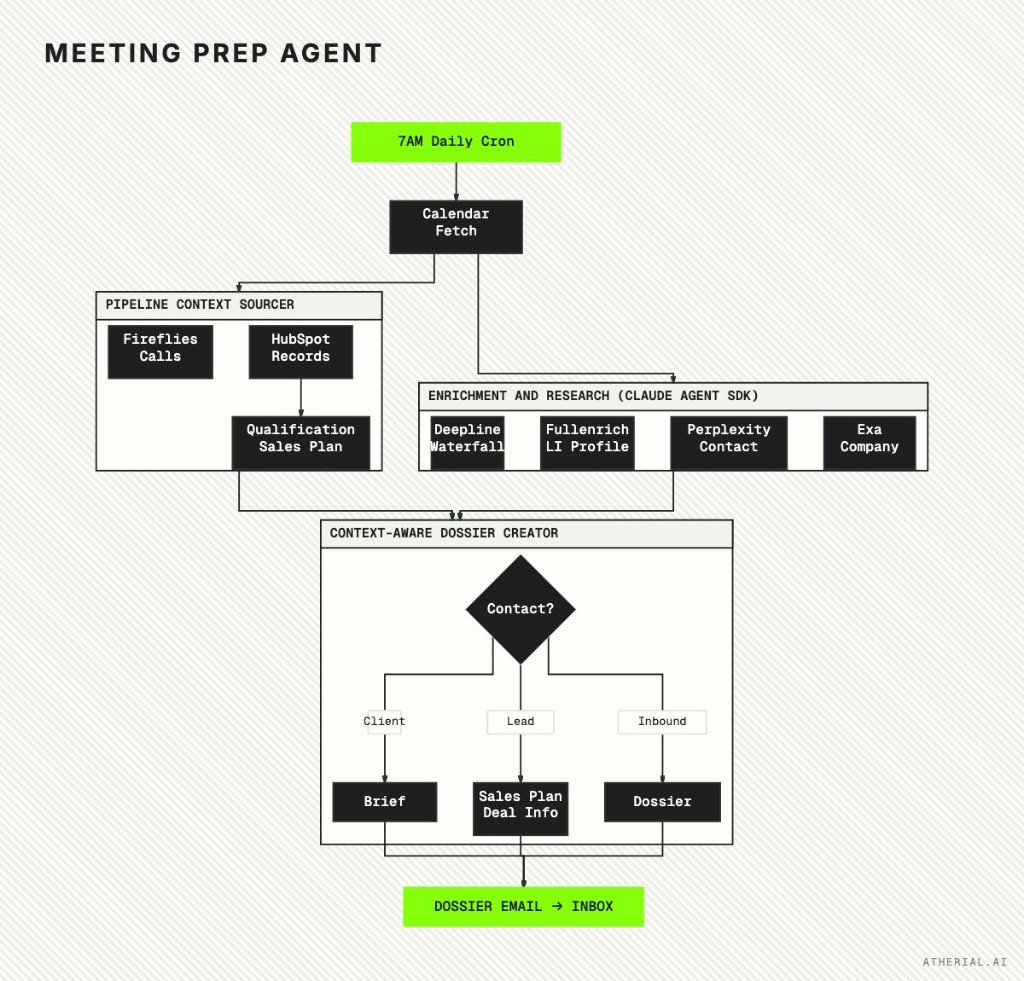
The Meeting Prep Agent

A custom research dossier in your inbox at 7am.

01

Fetch & Classify

A 7am cron fetches your calendar. HubSpot classifies attendees as active clients, prospects in pipeline, inbound leads, or networking contacts.

02

Enrich & Research

Runs a research playbook: Fullenrich for LinkedIn, Exa for company site, Perplexity API for web synthesis with citations, and Fireflies for past call history.

03

Deliver Automatically

Claude Agent SDK reads all of it, generates a custom context-aware dossier email, and delivers it via Resend. Results write back to HubSpot.

Meeting Prep Agent workflow diagram showing 7am daily cron, calendar fetch, pipeline context sourcer, enrichment and research, and context-aware dossier creator
AI Employee 04 · Deck & Proposal Builder

The Proposal & Deck Generator

11 slash commands. 9 skills. Discovery call to signed contract.

01

Build & Propose

Run /new-demo-deck to fetch Fireflies transcripts and build custom slides. Run /demo-proposal to convert the deck into a tailored proposal.

02

Contract & Invoice

Run /sow to turn the proposal into a Statement of Work ready for e-signature. Run /create-invoices to draft HubSpot invoices for SOW milestones.

03

Prep & Update

Run /hormozi-sales-plan to make sales scripts. Run /add-weekly-update to read git commits and build a client standup deck with Mermaid diagrams.

AI Employee 05 · Follow-Up Agent

The Post-Call Agent

From meeting to CRM, follow-up, and next steps, on sales and client calls.

01

Trigger & Classify

Receives a Fireflies webhook when the call transcript is ready. Pulls attendee emails and matches them to HubSpot Contacts and Deals.

02

Generate & Sync

Drafts a follow-up email in your voice, scores the lead on a 6-dimension MEDDIC scorecard, builds a custom demo deck brief, and syncs all of it to HubSpot.

03

Deliver Automatically

Sends you a complete email package via Resend containing the email draft, MEDDIC scorecard, next-meeting scripts, and demo deck link.

How to Build: (1) Fireflies webhook → (2) HubSpot Private App Token matching → (3) Three Claude prompts (Email, MEDDIC, Deck Brief) → (4) Resend React Email delivery.
Post-Meeting Pipeline
01 · Trigger
Fireflies webhook fires when transcript is ready
↓
02 · Classify
HubSpot match emails → contacts + deals · prospect / client / networking
↓
03 · Generate
Claude drafts follow-up email · MEDDIC score · demo deck brief
↓
04 · Sync
HubSpot saves draft + scorecard + sales plan to the deal
↓
05 · Deliver
Resend packages draft + score + deck link to your inbox
AI Employee 06 · AEO Agent

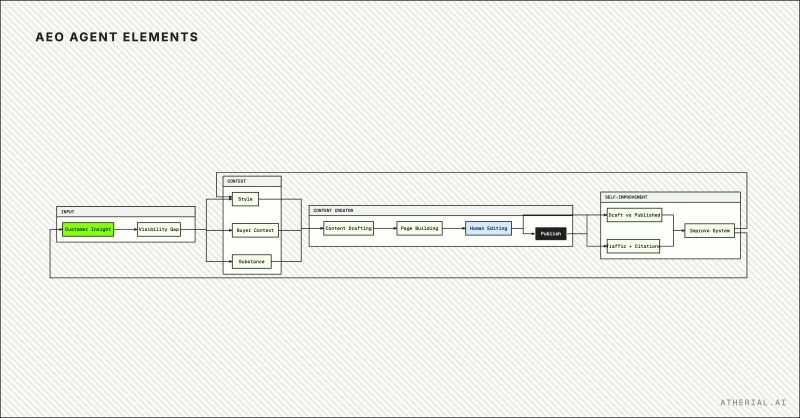
The AEO Agent

Show up in the AI answers your buyers prompt.

01

Stimulus & Context

Uses sales transcripts and Reddit threads to capture exact buyer questions. Pipes in synthetic buyer context (tech stack, vertical) to target 10x more prompts.

02

Substance & Style

Combines proprietary data/expertise (knowledge base or interviews) with your brand guidelines to write value-added pages. Marginal cost is under a dollar.

03

Human-in-the-Loop & Analytics

Humans spend 2 minutes editing drafts, feeding edits back to improve agent quality. Tracks AI referral traffic and self-reported attribution.

AEO Agent Elements diagram showing input, context, content creator, and self-improvement loops
Hover to zoom
AI Employee 07 · Client Communicator

Auto Loom makes client demo videos for you

The agents and internal AI tools you build live or die on how well you get context and feedback from stakeholders. The best way to get that is a demo. The slowest way is recording a Loom manually.

01

Drives the browser

Launches Playwright to use what you are building in the browser (scrolling, highlighting, and clicking in sync).

02

Writes and speaks

Writes an engaging script in your tone, then calls ElevenLabs API to record voiceover in your cloned voice.

03

Muxes and outputs

Muxes audio and video into a single MP4 with ffmpeg. Stakeholders watch and comment async without meetings.

AI Employee 08 · Playbook Agents

Playbook Agents

Custom agents that run your delivery playbooks and encode your SME.

01

Your playbook, not a generic workflow

Every agency delivers differently. These agents run the way your best people already work: research, briefs, production, QA, not a one-size tool.

02

Encode subject-matter expertise

Interviews, examples, and corrections become skills and memory so the agent gets better at your craft, not just faster at filler.

03

Example: content strategy & repurposing

For a B2B marketing agency, we built an agent that researches and briefs the way they do, then repurposes each piece across verticals, buyer profiles, and formats.

Agency-Specific Delivery
01 · Capture SME
How your best people actually decide
↓
02 · Encode playbook
Skills · examples · quality bar
↓
03 · Run delivery
Research → brief → produce → review
↓
04 · Expand
Repurpose across ICP, vertical, format
AI Employee 09 · Finance Agent

The Finance Agent

Invoices, receivables, cash picture, and forecasts, without founder spreadsheet theater.

01

Invoicing & AR

Drafts invoices from SOW milestones, tracks what's outstanding, and nudges collections so cash doesn't wait on founder memory.

02

Live financial picture

Pulls a current view of cash, burn, and runway instead of a spreadsheet that's three weeks stale.

03

Scenario planning

Models hire-vs-build, win/lose a retainer, or land a big project, so capital decisions stop being gut feel.

Financial Operating Loop
01 · Bill
Invoices from milestones / SOWs
↓
02 · Collect
AR tracking and follow-ups
↓
03 · See
Cash · burn · runway
↓
04 · Decide
Hire · price · build vs buy scenarios
Part 4

How to Build and Deploy Them

Context Creation

Context turns a capable model into your employee

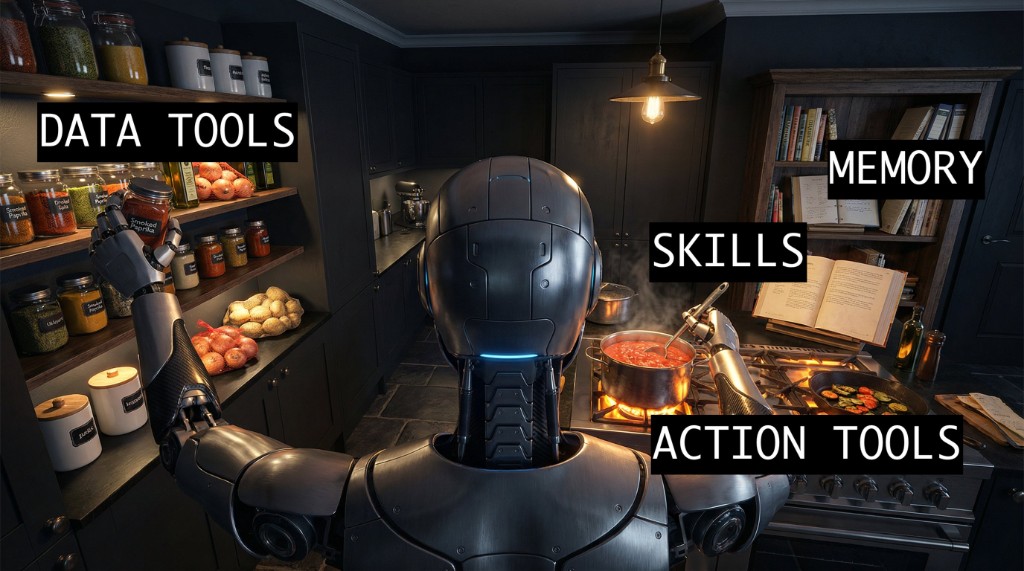
Data is the ingredients. Skills are the recipes. Tools are the stove. Memory is the bookshelf. An agent missing any one of those cannot cook for you, no matter how good the model is.

01

Data = Ingredients

Raw materials: client context, past call transcripts, guidelines, templates, and reference materials.

02

Skills = Recipes

The playbooks and instructions (like CLAUDE.md or custom `.md` skills) that tell the agent exactly how to combine the ingredients.

03

Tools & Memory = Stove & Bookshelf

Tools (APIs, CLI commands, browsers) let the agent act. Memory (vector databases, feedback tables) lets it remember and self-improve.

Context Kitchen diagram showing robot chef cooking with ingredients and recipes
Context Creation

The blocker is not the model. It is the unwritten playbook

The expertise that makes your agency good lives in your head and your best people's heads. Extracting it is the actual work. Five techniques teach an AI employee your judgment:

01

Discovery interviews

Structured interviews with subject matter experts to extract decision rules they do not even know they are using, like how your best strategist actually picks a content angle.

02

Process mapping

Document the real workflow step by step: inputs, decisions, handoffs, and exceptions. You cannot encode a playbook you have not made visible.

03

Evals

Test against real scenarios before client work. Expert rates outputs with a rationale, you improve context, then re-run. Graduate to an AI judge only after the human bar holds.

04

Human feedback

Every edit is training signal. Mark which leads were actually qualified. Feed corrections back so the agent self-improves. Sometimes the fix is just memory it did not have.

05

Prototyping as discovery

A working prototype surfaces requirements no interview or spec ever will. People cannot tell you what they want. They can tell you exactly what is wrong with what you showed them.

The Data Moat

Every engagement should improve the next one

Every edit your team makes is training signal. Learning from human feedback is the data moat actually operating, not just described.

01

Capture the judgment

Edits to drafts, qualified vs. unqualified lead marks, Reddit corrections, feed that judgment straight back into scoring and generation.

02

You compound, not the vendor

Rent a tool and the vendor compounds. Build your own and you compound. The first 10 engagements are hard. The next 10,000 get exponentially easier.

03

Sometimes it just needs memory

Other times the fix is simpler: the agent needed context it did not have. Past deliverables, calls, and edge cases become proprietary IP.

Self-Improvement Loop
01 Inputs Client conversations, briefs, call recordings
02 Extract How decisions get made & deliverables get created
03 Map Conversations → strategies & content
04 Memory Playbooks, edits, results, feedback
05 Better work Next engagement starts smarter
Data
Moat
Work → feedback → better playbook → better AI → better work
The Assembly Line

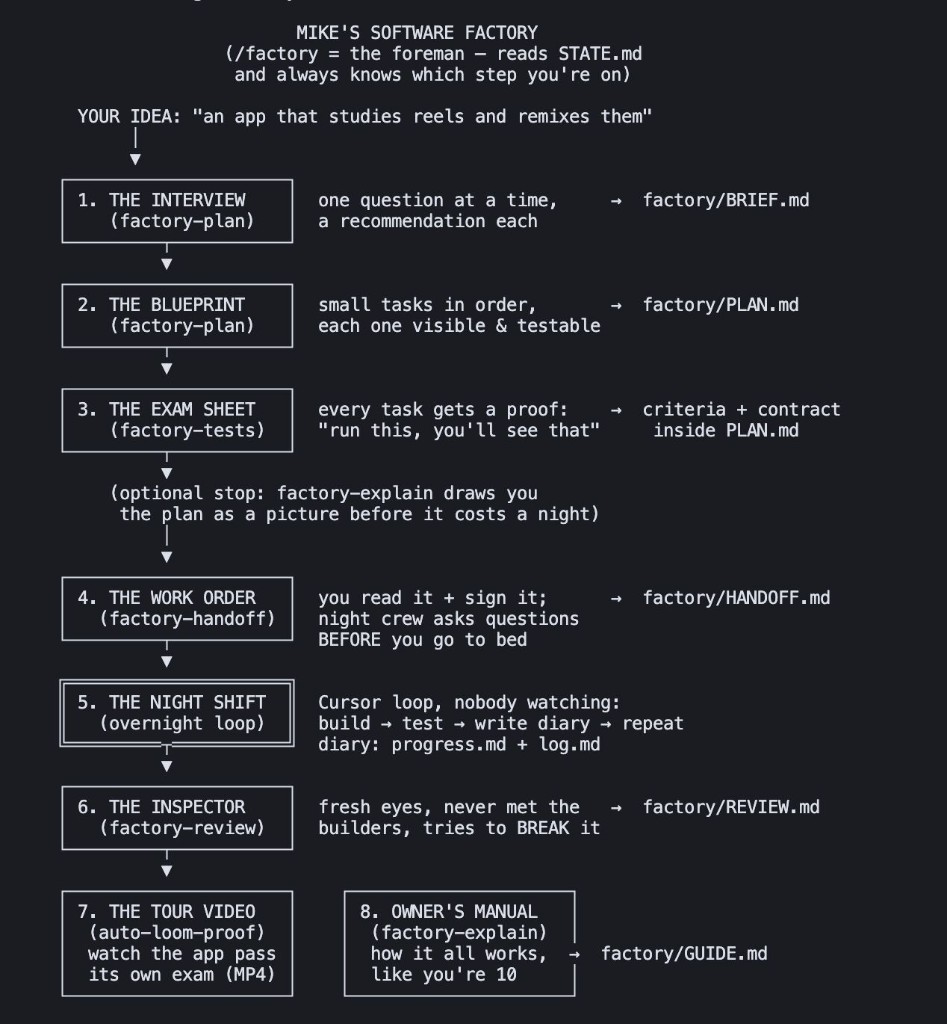
My Software Factory: Building products while you sleep

Cursor and Claude Code make writing code easy. The harder problem is building a system that context-engineers and manages itself. This is my personal assembly line that turns ideas into working code without babysitting.

01

The Interviewer (factory-plan)

Reads the codebase, interviews me to extract missing context, and writes a product brief.

02

The Planner (factory-plan)

Turns the approved brief into small, testable features and development tasks.

03

The Professor (factory-tests)

Defines success criteria and automated exams for each task before any code is written.

04

The Presenter (factory-explain)

Explains the plan to me like I'm 10, using visual metaphors and Mermaid charts.

05

CTO to SWE Handoff (factory-handoff)

Packages the plan, tests, and safety rails into a work order for lower-cost execution models.

06

The Coffee (Cursor /loop)

The night shift picks a task, builds it, takes its exam, and iterates with safety circuit breakers.

07

The Grader (factory-review)

A fresh agent that never met the builder reviews the code and tries to break the result.

08

Demo the Proof (auto-loom-proof)

Uses browser-use to record itself performing tests, adding ElevenLabs narration.

09

The Explainer (factory-explain)

Creates a simple owner's manual so I understand my codebase without outsourcing my thinking.

Mike's Software Factory diagram showing the 9-step assembly line
Cards on the table

If you want help finding and building your first AI employee, start here

Do it yourself

Start with a business goal, run the build-vs-buy test, and encode your playbook as context.